

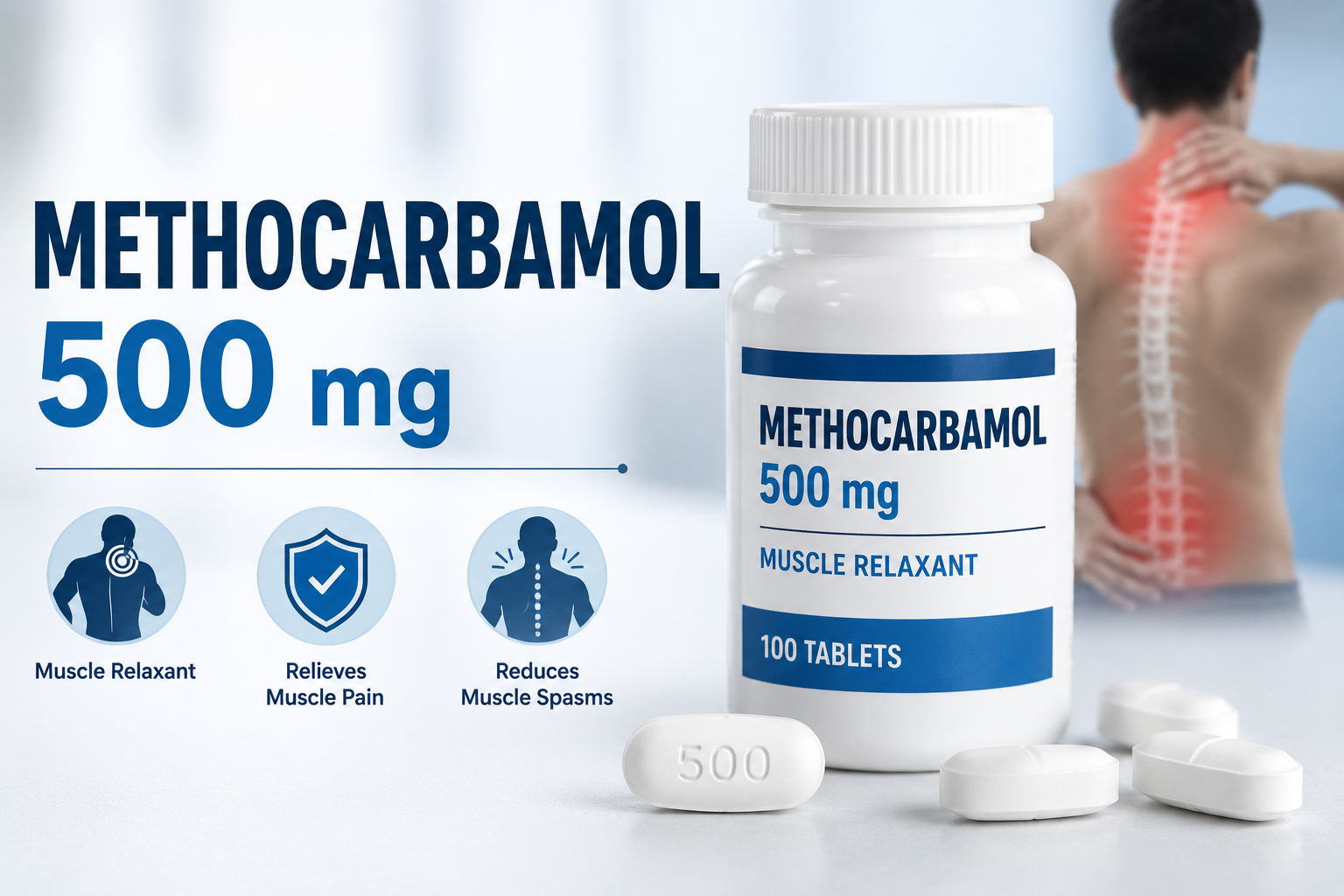
Methocarbamol is a prescription skeletal muscle relaxant used with rest, physical therapy, and other measures for acute painful musculoskeletal conditions. The 500 mg tablet is a common strength, but a prescribed dose may contain more than one tablet.
Updated for a U.S. audience in 2026
A prescription for methocarbamol 500 mg is commonly used to reduce discomfort associated with short-term muscle strains, sprains, spasms, and other acute musculoskeletal problems. Methocarbamol is the generic drug; Robaxin is a well-known brand name.
It does not work like ibuprofen, acetaminophen, or an opioid. The exact mechanism is not fully established, and the U.S. prescribing information notes that methocarbamol does not directly relax tense skeletal muscle. Its effect is thought to be related to depression of activity in the central nervous system, which is also why drowsiness and dizziness are important safety concerns.
Key Takeaways
- Methocarbamol 500 mg is a tablet strength, not necessarily the full dose a person is prescribed at one time.
- The drug is used as an adjunct to rest, physical therapy, and other measures for acute painful musculoskeletal conditions.
- Drowsiness and dizziness are common, so avoid driving or hazardous tasks until you know how the medicine affects you.
- Alcohol, opioids, benzodiazepines, sleep medicines, and other central nervous system depressants can increase sedation and impairment.
- Methocarbamol is generally intended for short-term musculoskeletal symptoms rather than as a treatment for chronic pain from any cause.
- Do not change the dose, double a missed dose, or stop another prescribed medicine in order to take methocarbamol without checking with a clinician or pharmacist.
What Is Methocarbamol 500 mg Used For?
Methocarbamol is prescribed for discomfort associated with acute musculoskeletal conditions. Examples include a painful back strain, neck strain, muscle spasm after an injury, or other short-term muscle-related pain where reducing spasm and sedation of overactive nervous-system activity may improve comfort.
It is usually only one part of treatment. Activity modification, gradual movement, physical therapy, heat or cold, and other pain-relief strategies may be used depending on the injury.
The current U.S. prescribing information states that methocarbamol should be used as an adjunct to rest, physical therapy, and other measures for acute painful musculoskeletal conditions. See the DailyMed methocarbamol 500 mg prescribing information.
Is Methocarbamol 500 mg a Painkiller?
Not in the usual sense. Methocarbamol is classified as a skeletal muscle relaxant. It does not reduce inflammation like an NSAID and does not act like an opioid pain medicine.
Someone may still feel less pain after taking it because a painful muscle spasm becomes easier to tolerate or because central nervous system activity is reduced. If the pain comes from a fracture, infection, internal organ problem, or nerve compression, methocarbamol does not correct that underlying cause.
This distinction is similar to other antispasmodic medicines that target different tissues. For example, JiffWellness’s guide to dicyclomine 10 mg explains that dicyclomine is used for intestinal smooth-muscle spasm and is not interchangeable with a skeletal muscle relaxant such as methocarbamol.
How Does Methocarbamol Work?
The exact mechanism has not been clearly identified. Methocarbamol is a central nervous system depressant with sedative and musculoskeletal-relaxant properties.
That wording matters because people sometimes assume it travels directly into a tight muscle and switches the contraction off. The label specifically notes that methocarbamol does not directly relax tense skeletal muscle in humans.
What Is the Usual Methocarbamol 500 mg Dosage?
Follow the exact directions on your prescription bottle. The 500 mg number tells you how much methocarbamol is in one tablet; it does not mean that every adult dose is one 500 mg tablet.
| Label information for adults | 500 mg tablets | Important point |
| Initial labeled regimen | 3 tablets four times daily | Equals 1,500 mg per dose |
| Maintenance labeled regimen | 2 tablets four times daily | Equals 1,000 mg per dose |
| Early treatment | Higher total daily dosing may be used briefly | The label notes 6 g/day for the first 48 to 72 hours; severe cases may receive more under medical direction |
| After the early period | Dose is usually reduced | The label states treatment can generally be reduced to about 4 g/day |
These are labeled adult dosing examples, not personalized instructions. Prescribers may use a different schedule based on age, other medicines, side effects, the condition being treated, and how long the drug is needed.
How Long Does Methocarbamol Take to Work?
Oral methocarbamol is absorbed fairly quickly. Some people notice sedation or symptom relief within the first few hours, but response varies.
The medication is generally used for acute symptoms, and it is not a substitute for evaluating pain that is severe, persistent, or unexplained.
What Are the Common Side Effects?
- drowsiness or sleepiness
- dizziness or lightheadedness
- blurred vision
- upset stomach or nausea
- headache
- reduced alertness or coordination
MedlinePlus also notes that methocarbamol can cause black, blue, or green discoloration of urine. See the MedlinePlus patient information for methocarbamol.
Because dizziness and drowsiness are common, do not assume you are safe to drive simply because you took the medicine at a prescribed dose. Learn how it affects you first.
Can You Drink Alcohol With Methocarbamol?
Alcohol can add to methocarbamol’s central nervous system depressant effects and make drowsiness, dizziness, poor coordination, and slowed thinking worse.
The same concern applies to other medicines that cause sedation. This can include opioids, benzodiazepines, sleep medicines, sedating antihistamines, and some other prescription drugs.
If you take more than one medicine that can make you sleepy, ask a pharmacist or prescriber to review the combination rather than assuming each drug is safe simply because it is prescribed.
What Medications Can Interact With Methocarbamol?
The most important practical interaction is additive sedation with alcohol and other central nervous system depressants. Methocarbamol can also interfere with the effect of pyridostigmine, a medicine used in conditions such as myasthenia gravis.
Always provide a complete medication list, including sleep aids, anxiety medicines, opioid pain medicines, antihistamines, cannabis products where applicable, and supplements that cause sedation.
Can Methocarbamol 500 mg Make You Sleepy?
Yes. Sleepiness is one of the most common reasons people notice the medicine. Some patients take it without major sedation, while others feel too impaired to drive or work safely.
Sedation can be more problematic in older adults, people taking several medicines, and anyone combining methocarbamol with another central nervous system depressant.
Is Methocarbamol Safe for Older Adults?
Older adults can be more sensitive to dizziness, sedation, confusion, and fall risk from centrally acting muscle relaxants. Whether methocarbamol is appropriate depends on the reason for treatment, other medicines, kidney and liver health, fall history, and available alternatives.
A lower-risk plan may focus more heavily on physical therapy, targeted movement, topical treatments, or another strategy, but the prescriber should individualize the decision.
Can You Take Methocarbamol During Pregnancy or Breastfeeding?
Pregnancy and breastfeeding are situations where individualized medical advice matters. Tell the prescriber if you are pregnant, may become pregnant, or are breastfeeding before starting methocarbamol.
Do not assume that a medication used for a common muscle strain is automatically safe in pregnancy simply because it is not an opioid.
What Happens If You Miss a Dose?
Follow the instructions from your pharmacy. General patient guidance is to take a missed dose when remembered unless it is close to the time for the next dose.
Do not double the next dose to make up for a missed tablet unless your prescriber specifically tells you to do so.
What Happens If You Take Too Much Methocarbamol?
Overdose can cause excessive drowsiness and may be more dangerous when methocarbamol is combined with alcohol or other sedating drugs.
Reported overdose effects can include nausea, severe sedation, blurred vision, low blood pressure, seizures, and loss of consciousness. A suspected overdose needs urgent medical or poison-control guidance rather than home observation.
When Should Pain Be Evaluated Instead of Treated as a Muscle Spasm?
Methocarbamol makes the most sense when the working diagnosis is an acute musculoskeletal problem. Not every painful area is caused by a tight muscle.
Seek medical evaluation when pain follows major trauma, causes new weakness or numbness, comes with loss of bladder or bowel control, is accompanied by fever, occurs with chest pain or shortness of breath, or is severe and unexplained.
Pain under the right ribs is a good example of why location alone is not enough. JiffWellness’s guide to right upper quadrant pain explains how gallbladder, liver, kidney, lung, rib, and muscle problems can overlap, and why persistent or systemic symptoms need diagnosis rather than automatic treatment as muscle spasm.
How Can You Use Methocarbamol More Safely?
- Take it exactly as prescribed rather than using the 500 mg tablet strength to invent your own dose.
- Avoid driving or operating machinery until you know whether the medicine makes you drowsy or dizzy.
- Check before combining it with alcohol, opioids, benzodiazepines, sleep medicines, or other sedating products.
- Stand up slowly if you feel lightheaded.
- Use the medicine as one part of the treatment plan rather than replacing movement, rehabilitation, or evaluation of persistent pain.
- Contact the prescriber if side effects are significant or if the pain is not improving as expected.
Common Questions About Methocarbamol 500 mg
Is methocarbamol 500 mg strong?
It is one available tablet strength. Whether a dose is considered high or low depends on how many tablets are prescribed at one time and how often they are taken.
Is Robaxin the same as methocarbamol?
Yes. Robaxin is a brand name for methocarbamol. Generic products contain the same active drug, although inactive ingredients and tablet appearance can differ.
Can methocarbamol help back pain?
It may be used short term when back pain involves acute muscle spasm or strain. It does not treat every cause of back pain.
Can I take methocarbamol with ibuprofen?
These drugs work differently and are sometimes used together, but whether the combination is appropriate depends on your health conditions and other medicines. Ask your prescriber or pharmacist.
Is methocarbamol a narcotic?
No. Methocarbamol is not an opioid or narcotic. It is a centrally acting skeletal muscle relaxant.
How long should you take methocarbamol?
It is generally used for acute musculoskeletal symptoms, so the duration is usually short. Follow the prescription and ask the prescriber if you still need it after the expected recovery period.
The Bottom Line
Methocarbamol 500 mg is a common tablet strength of a prescription skeletal muscle relaxant used with rest, physical therapy, and other measures for acute painful musculoskeletal conditions. The 500 mg printed on the tablet is not necessarily the full prescribed dose.
The main safety issues are drowsiness, dizziness, impaired coordination, and additive sedation with alcohol or other central nervous system depressants. Take it according to the prescription label, avoid self-adjusting the dose, and have persistent, severe, or unusual pain evaluated rather than assuming it is simply a muscle spasm.
Medical Note
This article is for general educational purposes and is not a substitute for medical advice, diagnosis, or prescribing instructions. Use methocarbamol only as directed by a licensed health care professional and seek urgent care for a suspected overdose, severe allergic reaction, loss of consciousness, seizure, or serious neurologic symptoms.