

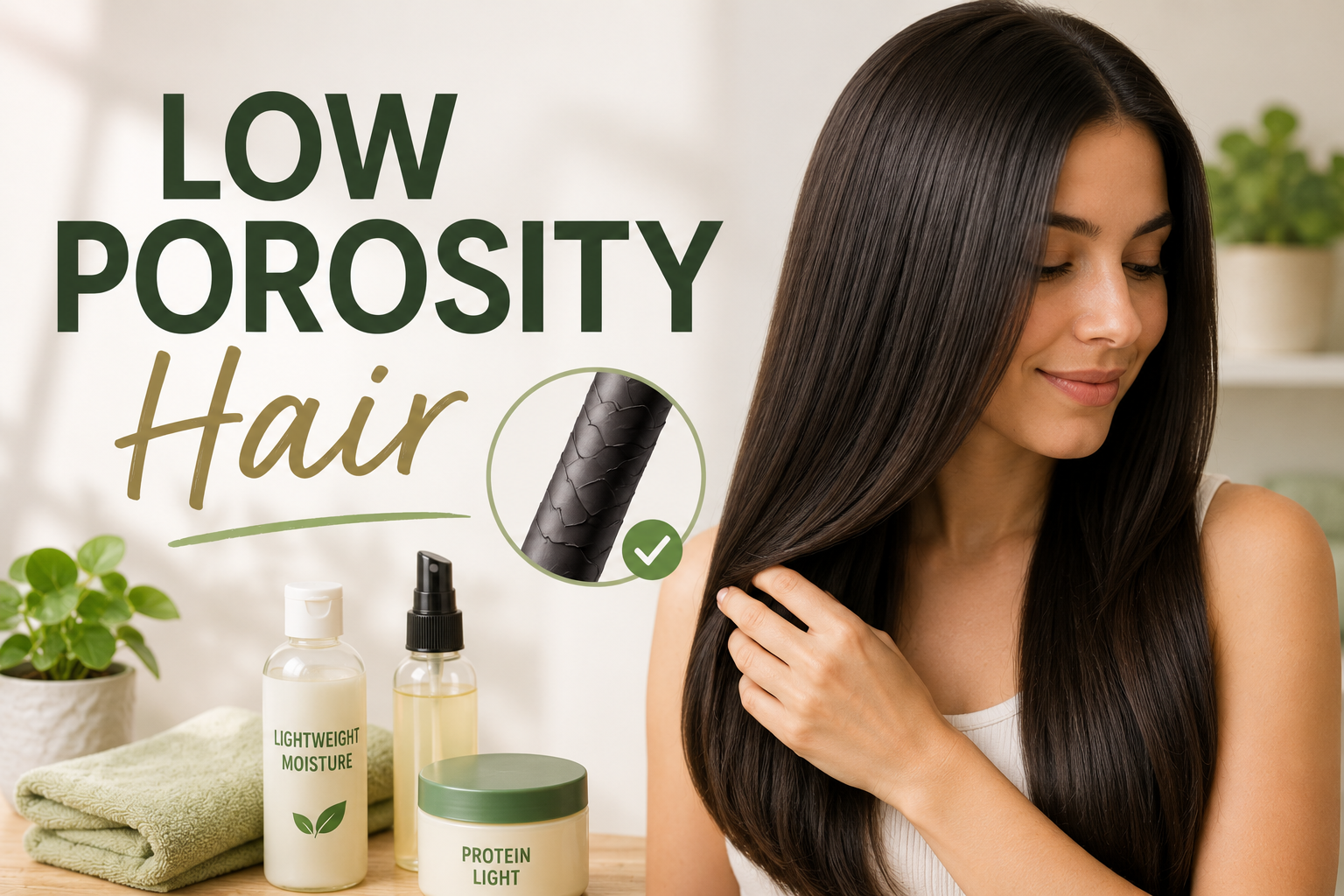
Low-porosity strands resist water at first because the outer cuticle layers sit relatively flat and compact. The right routine focuses on removing buildup, using lightweight moisture, and avoiding layers of heavy products that sit on the hair instead of improving manageability.
Updated for a U.S. audience in 2026
If your hair takes a long time to become fully wet, products seem to sit on top, and rich creams quickly make it feel coated, you may have low porosity hair. Hair porosity describes how readily a strand takes in and releases water and conditioning ingredients. It is influenced by the structure of the cuticle, the overlapping outer layer that protects the hair shaft.
Low porosity is not a disease and does not automatically mean unhealthy hair. In fact, compact cuticles can help hair hold onto moisture once it gets inside. The challenge is getting water and conditioning ingredients onto the strand without creating a heavy layer of buildup.
Key Takeaways
- Low porosity hair tends to wet slowly, resist product absorption, and develop buildup more easily than highly porous hair.
- The goal is not to force the cuticle open. Gentle cleansing, water-based conditioning, and careful product layering are usually more useful.
- Clarifying shampoo can help remove oils, silicones, butters, and styling residue, but over-clarifying may leave the hair dry.
- Lightweight conditioners and leave-ins generally work better than piling on several thick creams, oils, and butters at once.
- Warm water or gentle warmth during conditioning may improve how evenly products spread, but excessive heat can damage the hair shaft.
- Hair porosity can differ from root to end and can change with bleaching, coloring, chemical treatments, weathering, and heat damage.
What Is Low Porosity Hair?
Each hair shaft has an outer cuticle made of overlapping cells. When those cells lie relatively flat and closely packed, water does not move into the strand as quickly. That behavior is commonly described as low porosity.
By comparison, high-porosity hair has more pathways for water to move through the cuticle. It may absorb water quickly but also lose moisture quickly. Neither label tells you everything about your hair. Curl pattern, strand diameter, density, scalp oil, chemical history, and styling habits also affect which products work best.
What Are the Signs of Low Porosity Hair?
- Water beads on the surface before the hair becomes fully saturated.
- Shampoo and conditioner need more time or sectioning to spread evenly.
- Heavy creams, oils, or butters make the hair feel greasy, waxy, or coated.
- Hair may take a long time to air-dry after it finally becomes saturated.
- Styling products can leave visible residue or flakes when several products are layered.
- Deep-conditioning treatments may seem to sit on the surface rather than noticeably changing softness.
- The hair can feel dry even when a lot of product has been applied because buildup is not the same as hydration.
Low Porosity vs. High Porosity Hair
| Feature | Low porosity | High porosity |
| Getting wet | Often slow to fully saturate | Usually absorbs water quickly |
| Drying | May take a long time once saturated | Can lose water quickly |
| Product behavior | Heavy products may remain on the surface | Products may absorb quickly but moisture may not last |
| Buildup | Common when rich products are layered | Can occur, but dryness and roughness are often bigger concerns |
| Cuticle condition | Relatively compact and smooth | May have more lifted or damaged areas |
What Causes Low Porosity Hair?
For many people, porosity is partly a natural characteristic of the hair shaft. You can have low-porosity straight, wavy, curly, or coily hair.
Porosity can differ from roots to ends. Bleaching, permanent color, relaxers, repeated high heat, sunlight, and everyday wear can damage older lengths and make them more porous than new growth.
Does the Hair Float Test Really Tell You Your Porosity?
The popular float test involves placing a loose strand of hair in water and judging porosity by whether it floats or sinks. It can be a rough experiment, but it should not be treated as a precise test.
Oil, conditioner, styling residue, strand thickness, trapped air, and surface tension can all affect what the strand does in a glass of water. A more practical approach is to watch how clean hair behaves over several wash days: how quickly it wets, how products absorb, whether buildup develops, and how the hair responds to lightweight versus heavy formulas.
What Is the Best Routine for Low Porosity Hair?
A good routine is usually simpler than people expect. Start with clean hair, add water and conditioner in thin layers, then use only as much styling product as the hair actually needs.
1. Clean the Scalp and Remove Buildup
Low-porosity hair often looks and feels worse when old styling products accumulate. Shampoo the scalp according to how oily or dirty it becomes, then allow the lather to rinse through the lengths rather than aggressively scrubbing the entire strand.
The American Academy of Dermatology recommends washing based on how quickly the scalp gets dirty or oily, applying shampoo mainly to the scalp, and using conditioner after washing. See the AAD healthy hair-care recommendations.
2. Clarify When Regular Shampoo Is Not Enough
If the hair feels coated, dull, sticky, unusually stiff, or difficult to wet, a clarifying shampoo can remove accumulated oils and styling residue. You do not need to clarify on a rigid weekly schedule. Use it when buildup is actually present, then follow with conditioner.
People with hard water may also notice mineral residue that changes how the hair feels. In that situation, a chelating or mineral-removing shampoo may be more useful than repeatedly using a harsh cleanser.
3. Apply Conditioner to Very Wet Hair
Water is the main source of hydration. Instead of applying a thick conditioner to barely damp hair, fully wet the hair first and work in sections so the product can spread evenly.
Choose a conditioner that gives slip without leaving a waxy coating. Fine low-porosity hair may need a very light formula, while coarse or tightly coiled low-porosity hair may tolerate more conditioning as long as the product does not build up.
Conditioners mainly improve slip, reduce friction, and make hair easier to comb. A peer-reviewed overview of hair cosmetics explains how conditioners, oils, and silicones improve manageability.
4. Use Gentle Warmth, Not Excessive Heat
Some people find that a warm shower, warm towel, or short conditioning session under gentle heat makes a conditioner easier to distribute. Heat should remain comfortable rather than hot enough to dry, burn, or weaken the hair.
Frequent flat ironing, curling, or very hot blow-drying can damage the cuticle and eventually make older sections more porous. Use the lowest effective temperature and a heat-protectant product when heat styling.
5. Keep Leave-In Products Lightweight
Water-based sprays, milks, and light leave-in conditioners are often easier to manage than several layers of dense cream, butter, and oil. Start with a small amount and add more only where needed.
A leave-in should make detangling and styling easier, not make the hair feel sticky or coated. If the hair becomes progressively dull or hard to wet, reduce the number of layered products before assuming it needs more moisture.
Which Products Can Weigh Low Porosity Hair Down?
There is no universal blacklist, but very rich products can be difficult to layer on hair that already resists penetration. Large amounts of shea butter, cocoa butter, castor oil, waxes, pomades, and multiple styling creams may leave some low-porosity hair greasy or stiff.
Silicones are not automatically bad. Some people get excellent smoothness and heat protection from silicone-containing products. The practical issue is whether the formula builds up faster than your normal shampoo removes it.
Does Low Porosity Hair Need Protein?
Porosity alone does not tell you whether your hair “needs protein.” Hair itself is made primarily of keratin, but adding more protein-containing products is not automatically better.
Some hydrolyzed-protein treatments can temporarily improve the feel of damaged hair, while frequent use of a product that leaves a film may make certain low-porosity strands feel stiff or rough. If a protein-rich mask consistently makes your hair harder to detangle, use it less often rather than forcing it into the routine.
Can Vitamins or Diet Change Hair Porosity?
Nutrition supports hair growth from the follicle, but vitamins cannot directly open or close the cuticle of an existing hair shaft.
If you are considering biotin or a general supplement because of hair concerns, avoid assuming that more vitamins automatically improve hair texture. Deficiencies should be treated appropriately, while unnecessary high doses can create their own problems.
For a broader look at supplement labels and nutrient coverage, see Twiage Health’s guide to the best gummy multivitamin for women.
When Should You See a Dermatologist Instead of Changing Products?
- sudden or patchy hair loss
- a widening part or rapidly thinning hair
- persistent scalp itching, burning, pain, or tenderness
- thick scale, open sores, pus, or crusting on the scalp
- hair breaking close to the scalp despite gentle care
- new hair changes associated with fatigue, weight change, menstrual changes, or another health symptom
Porosity is a styling and hair-care characteristic. It does not explain true hair loss, scalp inflammation, or systemic symptoms, so those problems deserve a medical evaluation rather than another porosity test.
Common Questions About Low Porosity Hair
Is low porosity hair dry?
It can feel dry because water and conditioning products may not spread into the strand easily. However, low porosity does not automatically mean the hair lacks moisture.
Should low porosity hair avoid protein?
Not automatically. Porosity is not the same as protein sensitivity. Judge protein-containing products by how your hair responds rather than following a blanket ban.
What is the biggest mistake with low porosity hair?
A common mistake is adding more and more heavy product when the real problem is buildup. Simplifying the routine and cleansing appropriately often works better.
The Bottom Line
Low porosity hair is best managed with a simple routine: cleanse often enough to prevent buildup, fully wet the hair, use conditioner for slip, keep leave-ins lightweight, and limit heavy product layering. Gentle warmth can make conditioning easier, but high heat and aggressive chemical processing can damage the cuticle and change porosity over time.
You do not need to chase a perfect porosity score. Watch how your hair behaves from wash to wash and adjust one variable at a time. For more practical health and self-care explainers, browse Twiage Health.
Editorial Note
Hair porosity is a cosmetic hair-care concept rather than a medical diagnosis. Persistent hair loss, scalp disease, severe breakage, or sudden changes in hair quality should be discussed with a board-certified dermatologist.