

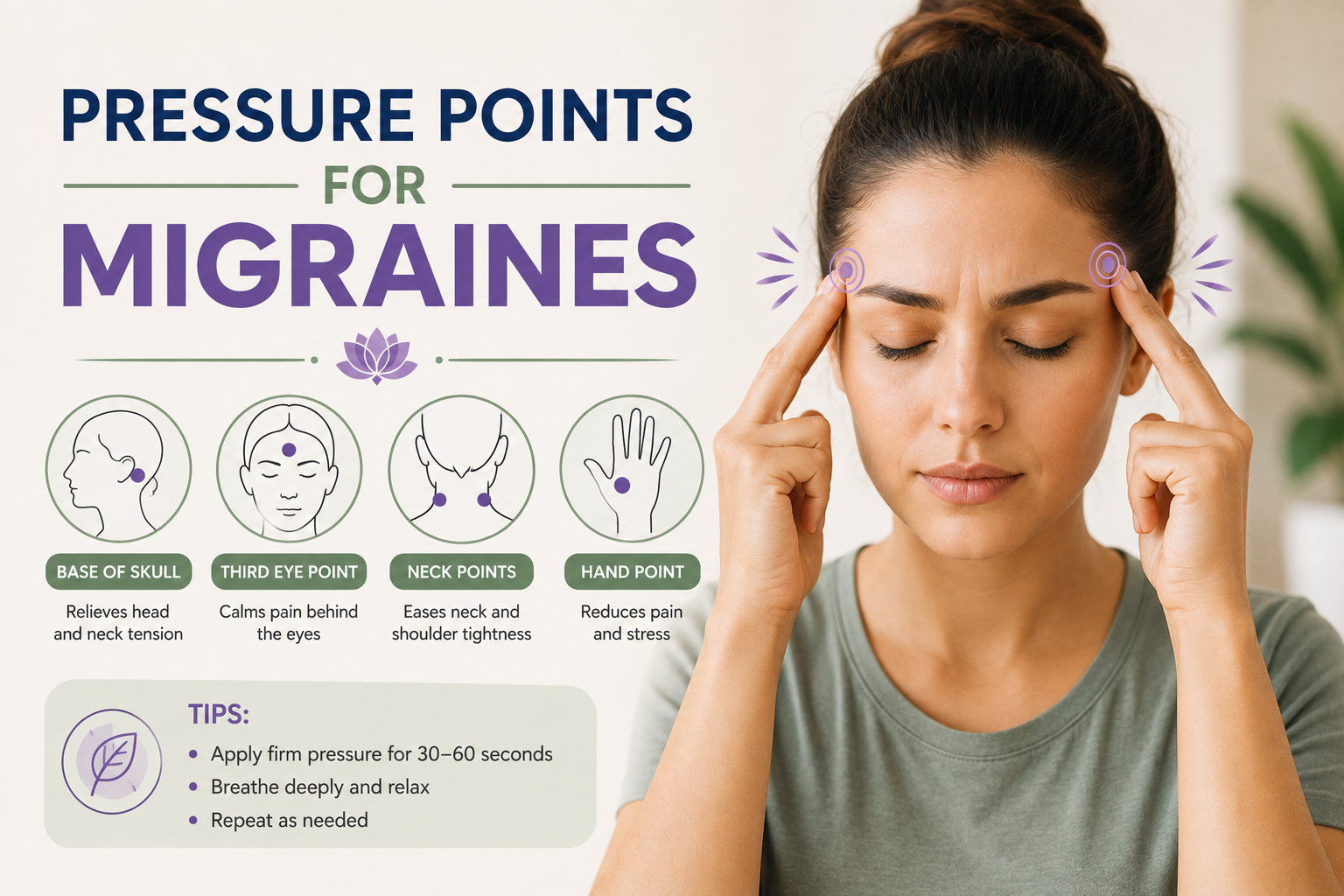
Using pressure points for migraines may give some people a simple, drug-free way to ease tension, nausea, or discomfort during a migraine attack. The evidence is limited compared with established migraine treatments, but gentle pressure on certain commonly used acupoints is generally low risk for most adults when used as a complementary technique.
Updated for a U.S. audience in 2026
Migraine is a neurological disorder, not simply a bad headache. An attack can include throbbing or pulsating head pain, nausea, vomiting, sensitivity to light or sound, dizziness, brain fog, and, for some people, visual or sensory aura. Because attacks can be disabling, many people look for pressure points for migraines that they can use at home while waiting for medication to work or when they want an additional non-drug option.
Acupressure uses fingers or thumbs to stimulate locations that are also used in acupuncture. Research specifically on self-acupressure for migraine is still limited. The stronger evidence is for acupuncture: the National Center for Complementary and Integrative Health reports moderate-quality evidence that acupuncture may reduce migraine frequency, although the difference compared with sham acupuncture is small. See the NCCIH review of acupuncture effectiveness and safety.
Key Takeaways
- Pressure points for migraines may be used as a complementary self-care technique, but they are not a proven substitute for acute or preventive migraine treatment.
- Commonly used points include LI4 on the hand, GB20 at the base of the skull, Taiyang at the temples, LV3 on the foot, GB41 on the foot, and PC6 on the inner wrist for nausea.
- Use steady, comfortable pressure rather than painful force. About 30 to 60 seconds per point is a reasonable starting range.
- Acupressure research is much less robust than acupuncture research, so claims that a particular point can stop a migraine should be treated cautiously.
- If a familiar migraine is not responding to your usual plan, talk with a clinician about evidence-based acute and preventive treatment options.
- A sudden severe headache, new weakness, trouble speaking, seizure, confusion, or a major change from your usual headache pattern needs urgent medical evaluation rather than acupressure.
Do pressure points actually help migraines?
They may help some people, but the evidence is not strong enough to say that pressing a specific point reliably stops a migraine attack. Acupressure may promote relaxation, reduce muscle tension, provide a competing sensory input, or simply give a person a structured calming routine during an attack. Those effects can be useful even when the exact traditional explanation for an acupoint is not scientifically established.
A small randomized trial of acupressure used alongside sodium valproate in people with chronic migraine with aura found improvement in migraine-related nausea but not a clear improvement in pain or quality of life. That is a good example of why acupressure should be framed as an add-on rather than a replacement for migraine care.
Where are the main pressure points for migraines?
Traditional acupressure systems name hundreds of points. The six below are among the most commonly discussed for head pain, neck tension, or migraine-related nausea. The locations are approximate, and there is no need to press hard enough to cause pain, bruising, numbness, or tingling.
| Pressure point | Where to find it | Why people use it | How to try it |
| LI4 (Hegu) | Fleshy web between the thumb and index finger, near where the hand bones meet | Head and facial pain in traditional practice | Pinch gently with the opposite thumb and finger for 30 to 60 seconds, then switch hands |
| GB20 (Fengchi) | Hollows at the base of the skull, just outside the thick neck muscles | Neck tension and occipital headache discomfort | Rest thumbs in the hollows and press upward gently for 30 seconds; avoid pressing directly on the spine |
| Taiyang (EX-HN5) | Tender depression at each temple, slightly behind the outer corner of the eye | Temple and side-of-head discomfort | Use fingertips to make slow, light circles for 30 to 60 seconds |
| LV3 (Taichong) | Top of the foot between the first and second metatarsal bones | A distal point traditionally used for head pain | Press with the thumb for 30 seconds on each foot without causing sharp pain |
| GB41 (Zulinqi) | Top of the foot between the fourth and fifth metatarsal bones | Traditionally used for lateral or side-of-head pain | Use gentle thumb pressure for about 30 seconds on each foot |
| PC6 (Neiguan) | Inner forearm, about three finger-widths below the wrist crease between two tendons | Nausea and motion-sickness type symptoms | Press or massage gently for 30 to 60 seconds on each wrist |
1. How do you use LI4 for migraine?
LI4, also called Hegu, sits on the back of the hand in the fleshy area between the thumb and index finger. To find it, bring the thumb toward the index finger and feel for the highest part of the muscle bulge, then relax the hand.
Use the thumb and index finger of the opposite hand to apply steady pressure that feels firm but not painful. Hold for roughly 30 to 60 seconds while breathing slowly, then repeat on the other hand. If the point becomes sore, numb, or tingly, reduce the pressure or stop.
2. Can GB20 help when migraine comes with neck tension?
GB20 is located at the back of the head where the base of the skull meets the upper neck. Many people with migraine also experience neck tightness or tenderness, so this area can feel naturally soothing to massage.
Place both thumbs into the soft hollows on either side of the upper neck and apply mild upward pressure toward the skull for about 30 seconds. Keep pressure away from the center of the spine and do not press the front or side of the neck where major blood vessels and nerves run.
3. Is temple pressure safe during a migraine?
Light temple massage is usually comfortable for many people, but more pressure is not better. The temples can be extremely sensitive during migraine because touch itself may become painful, a symptom called allodynia.
If touch is soothing, place two fingertips on each temple and make slow circles for 30 seconds. If the skin or scalp is painfully sensitive, skip this point and use a less sensitive area such as the hand or wrist.
4. Why are foot pressure points used for head pain?
Traditional Chinese medicine includes distal points, meaning points located far from the area where symptoms are felt. LV3 and GB41 are examples on the feet. Modern research has not established that these exact foot points have a unique migraine-specific effect, so they are best understood as optional components of a relaxation or acupressure routine.
5. Can PC6 help migraine nausea?
PC6 on the inner wrist is best known as an acupressure point used for nausea rather than for head pain itself. Because nausea is a common migraine symptom, some people find it useful during an attack.
To locate it, place three fingers across the inside of the opposite wrist starting at the wrist crease. The point lies just below those fingers between two prominent tendons. Apply gentle pressure for 30 to 60 seconds and repeat on the other wrist.
How long should you press migraine pressure points?
There is no medically established perfect duration. For home use, short sessions are reasonable. Try steady pressure or slow circular massage for about 30 to 60 seconds, release, and repeat once if it remains comfortable. A full routine using several points may take only a few minutes.
Stop if pressure increases the headache, causes dizziness, produces sharp pain, or leaves the area bruised. Acupressure should feel like massage or sustained pressure, not an endurance test.
When should you use pressure points during a migraine?
You can try gentle acupressure when you first notice a familiar migraine beginning, while resting during an attack, or between attacks as part of a relaxation routine. If you use prescription or over-the-counter migraine medication, do not delay a treatment that works best when taken early just because you are trying pressure points first.
A practical approach is to treat acupressure like a cold pack, dark room, hydration, or relaxation breathing: something that may improve comfort while the main migraine plan does its job.
Can acupressure prevent migraines?
There is not enough high-quality evidence to recommend self-acupressure as a stand-alone migraine preventive treatment. Acupuncture has more research behind it, and NCCIH notes moderate-quality evidence that it may reduce migraine frequency. That finding cannot automatically be assumed to apply equally to finger pressure at home.
People who have frequent attacks may benefit from a prevention plan that can include lifestyle regularity, trigger management, prescription preventive medications, CGRP-targeted therapies, neuromodulation devices, or other options selected with a clinician.
What else can you do during a migraine attack?
- move to a dark, quiet room if light and sound are triggering symptoms
- use a cool pack on the forehead, temple, or back of the neck if that feels soothing
- sip fluids if you are able to drink and dehydration may be contributing
- take your prescribed or clinician-recommended acute migraine treatment as directed
- avoid driving if vision, balance, concentration, or reaction time is impaired
- keep a migraine diary if attacks are becoming more frequent or difficult to predict
The National Institute of Neurological Disorders and Stroke describes migraine as a neurological condition with recurring attacks and outlines current approaches to diagnosis and treatment. Read the NINDS migraine overview.
Who should be careful with acupressure?
Gentle acupressure on intact skin is low risk for many adults, but there are situations where extra caution makes sense.
- do not press directly over a wound, burn, rash, infection, recent surgery site, fracture, or badly bruised area
- avoid aggressive neck pressure or manipulation, especially if you have vascular disease, recent neck injury, or unexplained neurological symptoms
- if you take blood thinners or bruise easily, keep pressure light
- if you are pregnant, ask your prenatal clinician before using points that traditional acupressure sources associate with labor or uterine contractions
- children and older adults with fragile skin should use especially gentle pressure
When is a headache too serious for pressure points?
Pressure points are appropriate only for a headache pattern you recognize and can safely manage at home. A new or unusually severe headache can sometimes signal stroke, bleeding, infection, or another urgent problem.
- a sudden, explosive headache that reaches maximum intensity within seconds or minutes
- a severe headache described as the worst headache of your life
- new weakness, numbness, facial droop, trouble speaking, confusion, or loss of coordination
- a headache with seizure, fainting, or major change in consciousness
- headache after a significant head or neck injury
- headache with fever and marked neck stiffness
- a new headache pattern during pregnancy or soon after delivery
- a major change in a known migraine pattern, especially if attacks are becoming rapidly more frequent or neurologic symptoms are different from usual
NINDS advises urgent assessment for headaches accompanied by neurological loss such as weakness or loss of sensation, because those symptoms can be signs of stroke or another serious condition. See the NINDS headache warning-sign guidance.
Common Questions About Pressure Points for Migraines
What is the best pressure point for migraines?
There is no scientifically proven single best point. LI4, GB20, and the temples are among the most commonly used locations, but response varies from person to person.
Can you stop a migraine by pressing between your thumb and index finger?
Some people find LI4 soothing, but there is not strong evidence that pressing it reliably stops a migraine. It is best used as an optional comfort measure alongside an established migraine plan.
Do pressure points work for migraine with aura?
Acupressure has not been proven to stop aura. If you have a familiar aura, follow the treatment plan your clinician has recommended. New or unusual visual, speech, sensory, or weakness symptoms need medical evaluation.
Can pressure points help a migraine behind the eyes?
Temple massage, LI4, and other acupoints are commonly used for facial or frontal discomfort, but pain behind the eye can have many causes. Severe eye pain, vision loss, or a red painful eye needs prompt assessment.
Should pressure points hurt when you press them?
No. Mild tenderness can occur, but the pressure should remain tolerable. Sharp pain, numbness, bruising, dizziness, or worsening headache means you should stop.
Can I use acupressure and migraine medication together?
For most people, gentle acupressure can be used as a complementary measure while following a prescribed migraine treatment plan. Do not delay time-sensitive medication or change a prescription because acupressure seems helpful.
What is the bottom line on pressure points for migraines?
Pressure points for migraines can be a simple, inexpensive self-care technique when used with realistic expectations. LI4 on the hand, GB20 at the base of the skull, the temples, LV3 and GB41 on the feet, and PC6 on the wrist are commonly used locations. Gentle pressure for 30 to 60 seconds may help some people relax, ease muscle tension, or reduce nausea.
The evidence for self-acupressure is limited, and no pressure point has been proven to switch off migraine reliably. Use acupressure as an add-on to an evidence-based migraine plan, not as a reason to delay effective medication or medical care. If your headaches are changing, becoming frequent, or accompanied by neurological warning signs, seek professional evaluation.
Medical Note
This article is for general educational purposes and is not a substitute for medical advice, diagnosis, or treatment. People with new, severe, rapidly changing, or neurologically complicated headaches should seek medical care rather than relying on acupressure.
Editorial Sources
This 2026 update was informed by current U.S. information from the National Center for Complementary and Integrative Health and the National Institute of Neurological Disorders and Stroke, plus peer-reviewed migraine and acupressure research. The HealthCentral reference was used for search intent and topic coverage only.