

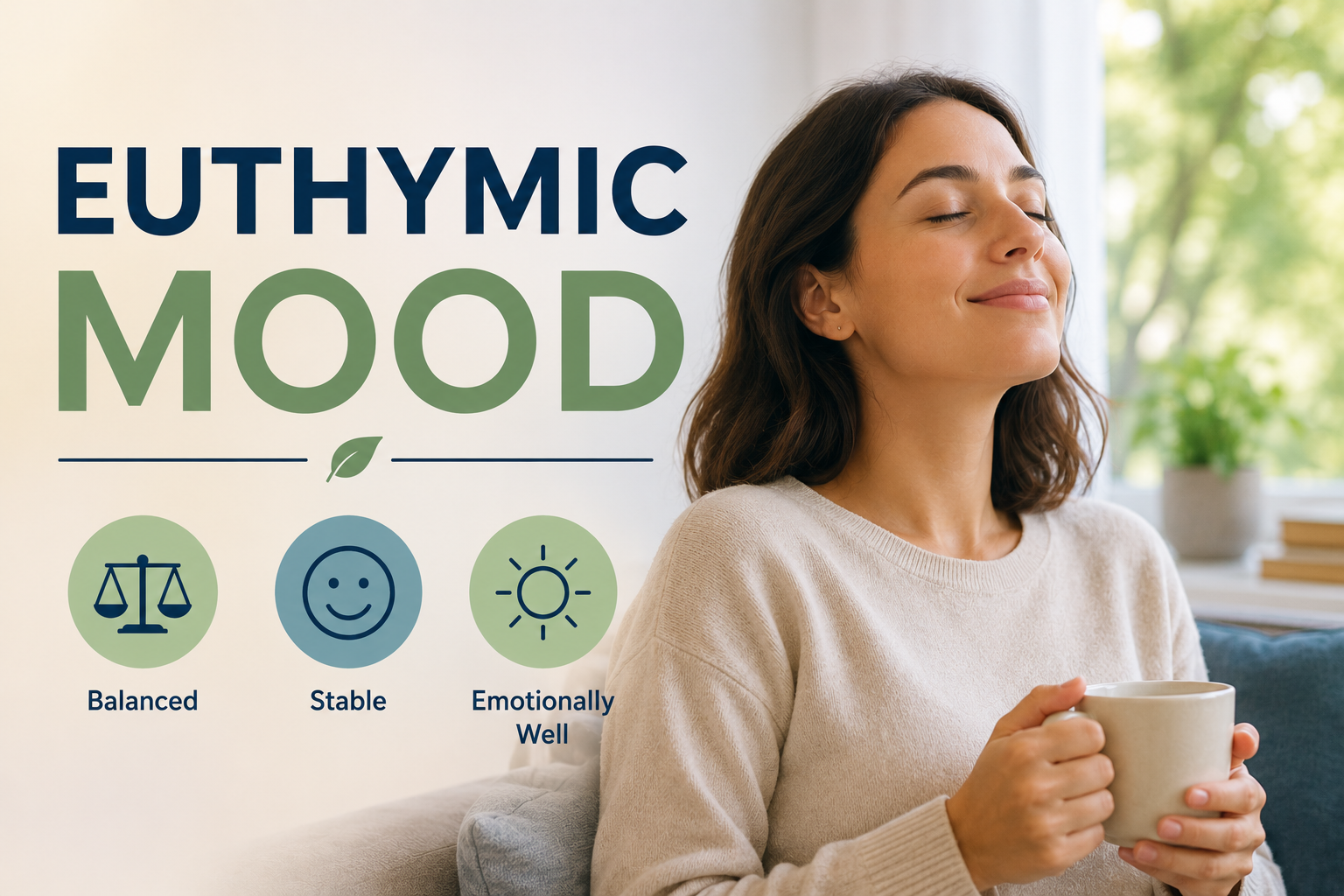
If you are trying to understand euthymic mood meaning, euthymic refers to a relatively stable, balanced mood without a current major depressive, manic, or hypomanic episode. The term is especially common in bipolar disorder care, but euthymia does not necessarily mean a person feels happy all the time or has no symptoms at all.
Updated for a U.S. audience in 2026
In everyday conversation, people often describe mood as good, bad, happy, sad, calm, or stressed. In psychiatry, clinicians sometimes need a more precise word for the period when mood is neither pathologically elevated nor clinically depressed. That word is euthymic.
Euthymia is most often discussed in relation to bipolar disorder because bipolar illness is defined by episodes of major shifts in mood, energy, activity, and concentration. A euthymic period is the comparatively stable time between significant mood episodes. The National Institute of Mental Health describes bipolar disorder as involving clear shifts in mood, energy, activity levels, and concentration.
Key Takeaways
- Euthymic mood generally means a stable or neutral mood without a current major depressive, manic, or hypomanic episode.
- Euthymia is not the same as being constantly happy, cheerful, or symptom-free.
- In bipolar disorder, clinicians may use euthymic to describe a period between mood episodes when the person is relatively stable.
- Some people can still have mild residual symptoms, sleep problems, anxiety, cognitive difficulties, or functional challenges while considered euthymic.
- Being euthymic does not mean bipolar disorder has been cured. Ongoing treatment may still be important for preventing relapse.
- The meaning of euthymic depends on clinical context, so the term should not be used as a self-diagnosis or as a reason to stop medication.
What does euthymic mood mean?
Euthymic mood is a psychiatric term for a mood state that is relatively even and within a person’s usual range. It is not significantly depressed and is not abnormally elevated, expansive, or irritable in the way that mania or hypomania can be.
The word is often used in mental-status examinations, psychiatric notes, research studies, and bipolar disorder treatment. A clinician might write that a patient is euthymic when the person appears emotionally stable and does not currently meet criteria for a major mood episode.
Does euthymic mean happy?
Not necessarily. Euthymia is closer to emotional stability than to happiness. A euthymic person can still feel disappointed, worried, tired, bored, excited, or sad in response to ordinary life events. Those normal shifts are different from a sustained mood episode that causes major changes in sleep, energy, judgment, behavior, or functioning.
Someone who is euthymic may describe the experience as feeling like themselves again, feeling steady, or having a more predictable emotional range. Another person may simply feel neutral rather than noticeably good.
How is euthymia different from mania, hypomania, and depression?
| Mood state | Typical mood pattern | Energy/activity | Common clinical meaning |
| Euthymic | Stable, balanced, or neutral | Near the person’s usual baseline | No current major mood episode |
| Manic | Abnormally elevated, expansive, or irritable | Markedly increased; may include reduced need for sleep and risky behavior | A severe mood episode that can impair functioning and may require hospitalization |
| Hypomanic | Elevated, expansive, or irritable but less severe than mania | Increased energy and activity | A distinct change from baseline that is noticeable but does not cause the same degree of severe impairment as mania |
| Depressive | Persistently low, sad, empty, hopeless, or sometimes irritable | Often reduced, though agitation can occur | A depressive episode can affect sleep, appetite, concentration, motivation, and functioning |
| Mixed features | Manic or hypomanic and depressive symptoms overlap | Can be high, restless, or variable | Symptoms from opposite mood poles occur together |
MedlinePlus similarly describes bipolar disorder as involving episodes of intense elevated or energized mood and episodes of depression, with some people having periods without major symptoms between episodes. See the MedlinePlus overview of bipolar disorder.
Why is the term euthymic used so often in bipolar disorder?
Bipolar disorder is episodic for many people. A person may experience mania, hypomania, depression, or mixed symptoms at different times, followed by periods of relative stability. Clinicians need language to describe that stable interval, and euthymia is one of the terms commonly used.
Treatment for bipolar disorder often has two broad goals: bring an active mood episode under control and reduce the chance that another episode will occur. A person who becomes euthymic after treatment may feel much better, but maintenance care can still matter because the underlying vulnerability to future episodes remains.
Does euthymic mean bipolar disorder is in remission?
The terms overlap but are not identical in every context. Euthymic usually describes the current mood state, while remission is a broader clinical term that may be defined by symptom severity, duration, and functioning. A clinician or research study may use specific criteria for remission that go beyond simply describing mood as euthymic.
Can you still have symptoms while euthymic?
Yes. Euthymic does not always mean completely symptom-free. Some people with bipolar disorder continue to experience mild or residual symptoms between full episodes. These can include sleep disruption, anxiety, irritability, reduced motivation, attention or memory difficulties, or lingering depressive symptoms that do not reach the threshold for a major episode.
This distinction is important because functioning can remain affected even when a person no longer meets criteria for mania or major depression. A treatment plan may therefore address sleep, anxiety, cognition, relationships, substance use, work or school functioning, and relapse prevention in addition to mood stability.
What does “mood euthymic” mean in a psychiatric note?
In a mental-status examination, a clinician may document both mood and affect. Mood is the person’s sustained internal emotional state, while affect is the emotional expression observed during the visit. A note saying “mood euthymic” generally means the clinician did not identify significant depression, mania, or hypomania at that time.
The wording does not necessarily mean every part of the mental-status exam was normal. A person could have euthymic mood while still experiencing anxiety, sleep problems, cognitive symptoms, medication side effects, or another psychiatric condition.
Is euthymic mood the same as normal mood?
Often, euthymic is used to communicate something close to a person’s normal or baseline mood. However, “normal” is not identical for every individual. Some people naturally have more energetic, reserved, expressive, or serious temperaments. Clinicians look for whether mood is stable and appropriate to context rather than expecting everyone to display the same emotional style.
What can a euthymic period feel like?
A euthymic period may feel less dramatic than either mania or depression. Sleep may become more regular, thinking may feel clearer, and daily responsibilities may become easier to manage. Impulsive urges may lessen, and the person may be better able to judge consequences and maintain routines.
At the same time, the absence of a dramatic high can sometimes feel unfamiliar to someone who has experienced hypomania or mania. Stable mood may initially seem flat or less exciting even when it represents healthier functioning. That experience is one reason medication changes should be discussed with a prescriber rather than made based only on whether stable mood feels different.
Should treatment continue when someone is euthymic?
Often, yes. For bipolar disorder, maintenance treatment is commonly used to reduce the risk of future manic, hypomanic, or depressive episodes. The exact plan depends on the bipolar subtype, past episode severity, medication response, side effects, pregnancy considerations, other medical conditions, and the person’s preferences.
Stopping a mood stabilizer or other psychiatric medication abruptly can increase the risk of relapse or withdrawal effects for some medications. A person who feels stable should still discuss any medication change with the clinician managing treatment.
NIMH notes that bipolar disorder is typically treated with medication, psychotherapy, or a combination of treatments, and that treatment can help people manage symptoms and improve quality of life. Review the NIMH bipolar disorder treatment overview.
How can someone protect a euthymic period?
A stable period is often a good time to strengthen routines that make early changes easier to notice. Relapse prevention can include taking medication as prescribed, keeping regular sleep and wake times, limiting alcohol and recreational drugs, attending therapy or follow-up appointments, and identifying personal warning signs.
- needing much less sleep without feeling tired
- a sudden increase in energy, talking, spending, risk-taking, or goal-directed activity
- growing irritability or agitation
- withdrawing from others or losing interest in usual activities
- sleeping much more or much less than usual
- rapid changes in concentration, confidence, hopelessness, or motivation
Early warning signs differ from person to person. Tracking sleep, energy, mood, and behavior can help a person and clinician recognize patterns before a full episode develops.
What other mood terms are related to euthymia?
- Dysthymic: Historically used to describe a persistently low or depressive mood; the diagnostic terminology for chronic depression has changed over time.
- Hyperthymic: Describes a persistently energetic, upbeat, confident, or active temperament in some psychiatric literature. It is not the same as a temporary manic episode.
- Cyclothymic: Can refer to fluctuating mood tendencies and is also part of the name cyclothymic disorder, a distinct bipolar-spectrum condition.
- Labile mood: Means mood shifts rapidly or is unusually changeable.
- Flat or blunted affect: Describes reduced outward emotional expression and is not another word for euthymia.
Common Questions About Euthymic Mood
Is euthymic a diagnosis?
No. Euthymic is a description of mood state, not a standalone mental health diagnosis.
Can someone without bipolar disorder be euthymic?
Yes. The term can be used more broadly in psychiatry to describe a stable, non-depressed, non-manic mood state, although it is especially common in bipolar disorder discussions.
Can a person be euthymic and anxious?
Yes. Euthymia refers mainly to mood stability. A person can still have an anxiety disorder or significant anxiety symptoms while not being manic or depressed.
Can someone be euthymic and still have insomnia?
Yes. Sleep problems can persist outside a major mood episode. Because sleep disruption can also be an early warning sign of relapse in bipolar disorder, persistent changes should be discussed with the treatment team.
Does euthymia mean medication is working?
It may be one sign that a treatment plan is helping, but mood stability can also reflect the natural course of illness. Clinicians consider episode history, functioning, side effects, adherence, and other symptoms when judging treatment response.
How long does euthymia last?
There is no fixed duration. A euthymic period may last weeks, months, or longer. Duration varies with the person, illness course, treatment, sleep, stress, substance use, and other factors.
What is the bottom line on euthymic mood?
Euthymic mood means a relatively stable emotional state without a current major depressive, manic, or hypomanic episode. In bipolar disorder, it commonly describes the period between episodes when mood has returned closer to baseline.
Euthymia should not be confused with constant happiness, a cure for bipolar disorder, or complete absence of symptoms. Mild residual symptoms and functional challenges can remain, and ongoing maintenance treatment may still be important. If a person notices a return of major sleep, energy, mood, thinking, or behavior changes, contacting the treating clinician early can help reduce the chance of a full relapse.
Medical Note
This article is for general educational purposes and is not a substitute for diagnosis or treatment from a qualified mental health professional. Medication should not be started, stopped, or changed based on an online definition of euthymia.
Editorial Sources
This 2026 update was informed by current U.S. information from the National Institute of Mental Health and MedlinePlus. The HealthCentral reference was used for search intent and topic coverage only.